

What can you use as lube? What is safe and what is not
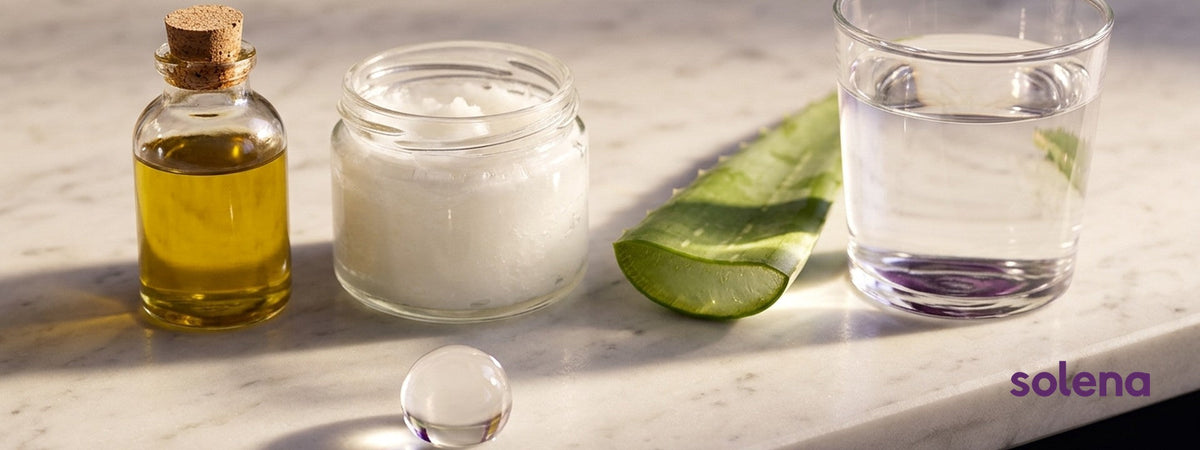
Oil, Vaseline, saliva, cream: what health sources say before you try.
By Sophie Dubois · 25 October 2026 · 8 min read
You run out of lubricant at the wrong moment, and the question comes up: what about olive oil? Vaseline? A bit of saliva? These quick fixes are common, but they do not all have the same effects on your body and on condoms.
This guide goes through everyday products, then helps you choose a suitable lubricant.
Key takeaways
- With a latex condom, use only a water-based or silicone-based lubricant. Oils, petroleum jelly and creams weaken latex.
- In the vagina, petroleum jelly is linked to more cases of bacterial vaginosis, and oils to Candida being found more often in a small study.
- Saliva does not weaken condoms, but it dries quickly and can pass on some infections.
- Water-based lubricant works with condoms and toys. For sensitive skin, choose a short ingredient list with no fragrance.
- Dryness that does not go away is worth a medical opinion.
🔎 Contents
- The quick answer, product by product
- Olive oil, coconut oil, butter: why avoid them?
- Vaseline as lube?
- Moisturiser and aloe vera
- Saliva as lubricant?
- What about homemade lubricant?
- Water-based or silicone-based: which to choose?
- Where to buy lubricant in Switzerland
- Dryness: when to see a doctor
- Lubricant FAQ
The quick answer, product by product
| Product | Latex condom | Keep in mind |
|---|---|---|
| Water-based lubricant | Yes | The most versatile |
| Silicone-based lubricant | Yes | Not with silicone toys |
| Olive or coconut oil | No | Can upset vaginal flora |
| Petroleum jelly | No | Linked to vaginosis |
| Moisturiser | No | Not made for mucous membranes |
| Saliva | Yes | Dries fast, infection risk |
The condom rule comes from the Swiss national prevention campaign. With a condom, only water-based or silicone-based lubricants are suitable. Fats and oils damage latex (LOVE LIFE). The Swiss AIDS Federation adds that the condom can become permeable and tear, even with no visible damage (aids.ch). The UK health service gives the same advice (NHS).
Olive oil, coconut oil, butter: why avoid them?
Oils glide well and for a long time. That is what makes them tempting. They still cause two problems.
Condoms. All oils, whether cooking, baby, coconut or mineral oil, weaken latex condoms, and so does butter (WHO, Family Planning Handbook). If you use a latex condom to protect yourself from infections or pregnancy, oil reduces that protection.
Vaginal flora. According to a US study published in 2013, Candida was found more often in women who used oils in the vagina. Candida is the fungus that causes thrush (Brown et al., Obstetrics & Gynecology, 2013). The study was small and observational, but it is a reason to be careful.
What about coconut oil, often described as "natural"? There is no solid study in humans on its use as a vaginal lubricant (Vanderschee and Kostov, Canadian Family Physician, 2025). A natural product is not necessarily made for intimate use.
💡 Solena tip
If you use non-latex condoms, check the packaging to see which lubricants are compatible. If in doubt, a water-based lubricant works with all condoms.
Vaseline as lube?
No, petroleum jelly (Vaseline) is not a good choice. It is greasy, so it damages latex just like oils do (aids.ch).
It is also linked to a higher risk of bacterial vaginosis, an imbalance of the vaginal flora. In the small US study mentioned above, some women had used petroleum jelly in the vagina during the previous month. Their risk of vaginosis was about 2.2 times higher (Brown et al., 2013). Other studies point the same way (Canadian Family Physician, 2025).
Moisturiser and aloe vera
Hand and body creams are not made for mucous membranes. The UK health service (NHS) advises against using creams or lotions in the vagina that are not meant for that purpose. They can cause irritation or infection (NHS). Lotions and creams also weaken latex (WHO, Family Planning Handbook).
The same goes for aloe vera gels sold for the skin: they are not designed for intimate use. If you like aloe vera, choose an intimate lubricant that contains it and states that it is compatible with condoms.
Saliva as lubricant?
Saliva does not weaken condoms (WHO, Family Planning Handbook). It does have two limits, though.
- It dries quickly. It feels wet, but it does not lubricate much and needs to be reapplied often.
- It can pass on infections. An Australian scientific review links saliva used as a lubricant to a risk of anal gonorrhoea in men who have sex with men (Chow and Fairley, Journal of the International AIDS Society, 2019). A US study also linked masturbation with saliva to recurrent thrush (Reed et al., Journal of Women's Health, 2003).
As an occasional quick fix, saliva is still an option with a condom. For regular use, a lubricant is more comfortable and safer.
What about homemade lubricant?
You can find recipes online based on cornflour, gelatine or oils. We advise against them. A homemade product has no controlled preservative, no suitable pH and no compatibility testing with condoms.
For comparison, the WHO recommends a pH of about 4 to 4.5 for vaginal use, close to that of the vagina. For anal use, it recommends a pH of 5.5 to 7 (Vanderschee and Kostov, Canadian Family Physician, 2025). A kitchen recipe cannot guarantee these values.
💬 Natural does not mean suitable for mucous membranes.
Water-based or silicone-based: which to choose?
For most people, water-based lubricant is the first choice. Silicone has advantages in some situations.
| Type | Strengths | Limits |
|---|---|---|
| Water-based | All condoms and toys, rinses off | Dries faster |
| Silicone-based | Lasts longer, more water-resistant | Not with silicone toys |
Silicone and silicone toys. Silicone-based lubricants can damage silicone items such as sex toys or menstrual cups (Canadian Family Physician, 2025). With these toys, choose a water-based lubricant. If you still want to try a silicone one, follow your toy manufacturer's instructions.
Sensitive skin. Lubricants high in glycerine or glycols can irritate some people (Canadian Family Physician, 2025). Go for a short ingredient list with no fragrance.
Where to buy lubricant in Switzerland
You can find lubricant in supermarkets, pharmacies and online. Migros, for example, sells water-based lubricants. Your pharmacist can also give you advice.
At Solena, our EasyGlide water-based lubricant, free from fragrance and parabens, is compatible with all condoms and sex toys. For anal play, where lubricant is essential, you can also read our guide to anal sex.
Dryness: when to see a doctor
Needing lubricant is common and nothing to worry about. Vaginal dryness can come from not being aroused enough, the menopause, pregnancy or breastfeeding. Some medicines, such as hormonal contraception or antidepressants, can also cause it (NHS).
According to the NHS, see a doctor if:
- the dryness lasts several weeks despite what you have tried;
- it affects your daily life;
- you have unusual discharge;
- you bleed after sex, between periods or after the menopause.
With a partner, take your time: desire, relaxation and everyone's consent matter as much as lubricant.
This article is for information only and does not replace advice from a health professional. If you have pain, itching, recurrent infections or ongoing dryness, talk to your doctor, your gynaecologist or a sexologist.
Lubricant FAQ
Can you use Vaseline as lube?
It is not recommended. Vaseline damages latex condoms and is linked to a higher risk of bacterial vaginosis. Use a water-based lubricant instead.
Can you use olive oil as lube?
Not with a latex condom, as it weakens it. In the vagina, oils are also linked to Candida, the fungus behind thrush, being found more often in a small US study. A water-based lubricant is safer.
Is coconut oil safe with condoms?
No, not with a latex condom. Coconut oil is an oil like any other: it weakens latex. There is also no solid study on its use as a vaginal lubricant.
Is it safe to use saliva as lube?
Saliva does not weaken condoms, but it dries quickly and can pass on some sexually transmitted infections. It can help in a pinch, but a lubricant is more comfortable and safer.
Can you use moisturiser as lube?
No. Skin creams are not made for mucous membranes and can cause irritation. The fats they contain also weaken latex condoms.
Water-based or silicone lube: which is better?
Water-based lubricant works with all condoms and toys and rinses off easily. Silicone lasts longer and is more water-resistant, but it can damage silicone toys.
Where can you buy lube in Switzerland?
In supermarkets, such as Migros, in pharmacies and online. Check that it is compatible with your condoms.
Can you make your own lube?
We advise against it. A homemade product has no controlled preservation, no pH suited to the vagina and has not been tested with condoms.
Article written by Sophie Dubois for Solena, a Swiss intimate wellness shop, based on the sources listed below. Learn more about Solena.
Sources
- LOVE LIFE (FOPH, Swiss AIDS Federation, Sexual Health Switzerland), "Condoms" (in French): lovelife.ch
- Swiss AIDS Federation, "External condom" (in French): aids.ch
- NHS, "Condoms": nhs.uk
- WHO / Johns Hopkins, Family Planning Handbook, "Lubricants for latex condoms": fphandbook.org
- Brown J. M. et al., "Intravaginal practices and risk of bacterial vaginosis and candidiasis infection", Obstetrics & Gynecology, 2013: PubMed 23635677
- Vanderschee S., Kostov J., Canadian Family Physician, 2025: PMC12312864
- Chow E. P. F., Fairley C. K., Journal of the International AIDS Society, 2019: PubMed 31468730
- Reed B. D. et al., Journal of Women's Health, 2003: PubMed 14709186
- NHS, "Vaginal dryness": nhs.uk

Comments