

The clitoris: anatomy, function and common myths
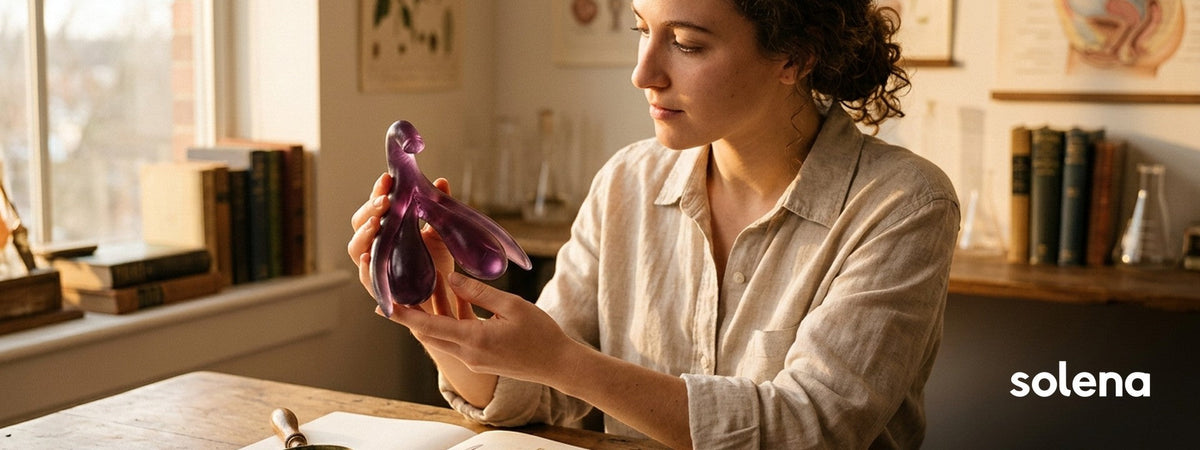
What we know about the clitoris today, with sources.
By Léa Müller · 22 October 2026 · 10 min read
When people talk about the clitoris, many picture a small button. Yet it is an organ of around ten centimetres in total, and most of it lies inside the body.
Its full anatomy was poorly represented for a long time, including in school textbooks. This guide sets out what we know today.
Key takeaways
- Around 90% of the clitoris is internal: only the glans is visible.
- It is made up of a glans, a body, two crura and two bulbs, largely formed of erectile tissue.
- Its main known role is pleasure. It forms a connected area with the urethra and the front wall of the vagina.
- The clitoris and the penis develop from the same structure in the embryo.
- Its size and shape vary a great deal from one person to another, and it changes over the course of life.
🔎 Contents
- What is the clitoris?
- What does the clitoris look like?
- What does the clitoris do?
- How many nerve endings?
- Clitoris and penis: the same origin
- A history long left incomplete
- Myths about the clitoris
- Every clitoris is different
- Getting to know your body
- Clitoris FAQ
What is the clitoris?
The clitoris is an organ of the vulva. Its visible part, the glans, sits at the top of the vulva, where the inner labia meet. It is partly covered by a fold of skin, the clitoral hood.
What you can see is only a small part of the organ. According to the University of Geneva, around 90% of the clitoris lies hidden inside the body (UNIGE, Campus no. 144, in French).
💬 The clitoris is less like a button than an iceberg.
What does the clitoris look like?
Seen as a whole, the clitoris has a shape close to an upside-down Y, or a wishbone. It extends deep into the body on either side of the vagina and the urethra.
| Part | What to know |
|---|---|
| Glans | Only visible part, very sensitive |
| Body (shaft) | Extends the glans inwards |
| Crura | Two branches along the pelvis |
| Bulbs | Two masses either side of the vagina |
Researchers who have studied its anatomy in detail describe an organ spread over several planes, with a large amount of erectile tissue in the bulbs and the body (O'Connell et al., Journal of Urology, 2005). This tissue fills with blood during arousal, like the tissue of the penis.
How big is it in total? You will often read "around ten centimetres". This is a common estimate, reached by adding up its different parts, rather than a single measurement. Above all, a meta-analysis of 21 studies shows that each part varies a great deal in size from one person to another (Longhurst et al., Clinical Anatomy, 2024).
What does the clitoris do?
The main known role of the clitoris is pleasure. Stimulating it, directly or indirectly, plays a central part in arousal and orgasm.
A connected area, not an isolated organ
Anatomical research describes the clitoris, the urethra and the front wall of the vagina as one connected whole (O'Connell et al., Journal of Urology, 2005). An ultrasound study showed that the roots of the clitoris are in contact with the vaginal wall and move during penetration, which suggests they can be stimulated (Foldès and Buisson, Journal of Sexual Medicine, 2009).
Clitoral or vaginal orgasm?
For a long time, a "clitoral" orgasm was set against a "vaginal" one, with the second presented as more "mature". This view, inherited from Freud, has been abandoned. Many researchers today describe an interconnected area. Whether distinct "types" of orgasm exist, however, is still debated.
To find out more, read our article on orgasm.
What about the G-spot?
One dissection study found no distinct anatomical structure that would correspond to a "G-spot" (Hoag et al., Journal of Sexual Medicine, 2017). It is better described as a sensitive area of the front wall of the vagina, probably linked to the clitoris and the urethra.
How many nerve endings?
You may have read that the clitoris has "8,000 nerve endings". This figure is everywhere, but it is not based on any count in humans.
In 2023, a US study counted the nerve fibres of the dorsal nerve of the clitoris for the first time. It puts their number at around 10,000 for the glans (Uloko et al., Journal of Sexual Medicine, 2023). The sample was very small, and some fibres were not counted: the real figure is probably higher.
A single nerve fibre branches into many endings, so the two figures do not measure the same thing. The main point to remember is that the glans is rich in nerves, which explains why it is so sensitive.
💡 Solena tip
This sensitivity explains why touch that is too direct can feel unpleasant. Gentle pressure, through the clitoral hood or around the glans, often works better. Everyone has their own preferences: the best way to find yours is to explore at your own pace.
Clitoris and penis: the same origin
In the embryo, the clitoris and the penis develop from the same structure, called the genital tubercle. Until around 8 to 9 weeks of pregnancy, they look alike (Baskin et al., Differentiation, 2018).
After that, depending on the action of hormones, this structure becomes a penis or a clitoris. This is why the two organs have comparable parts, such as a glans and erectile bodies. The clitoris is therefore not the "opposite" of the penis: they are two versions of the same starting point.
A history long left incomplete
You will often read that the clitoris was "discovered" in 1998. That is not accurate. Its bulbs and roots were already well described in the 19th century. Its full anatomy was then sidelined and rarely shown in medical books (UNIGE, Campus no. 144, in French).
Several pieces of work brought it back into view:
- 1998 and 2005: Australian urologist Helen O'Connell published dissections, then detailed MRI studies. She noted that the textbooks of the time contained inaccuracies (O'Connell et al., Journal of Urology, 1998).
- 2008-2009: gynaecologist Odile Buisson and surgeon Pierre Foldès studied the clitoris using ultrasound.
- 2016: researcher Odile Fillod made a 3D-printable model of the clitoris freely available (in French), used among other things for sex education in French-speaking Switzerland.
In 2019, the anatomical diagrams in French-speaking Switzerland's official teaching materials (MER) were changed to show the full clitoris, with input from Odile Fillod among others (same UNIGE source). Geneva University Hospitals (HUG) also held a lecture on its anatomical representations from the Renaissance to the present day (in French).
💬 An organ is not new just because people started drawing it correctly again.
Myths about the clitoris
| Myth | What we know |
|---|---|
| "It's a small button" | Around 90% is internal |
| "It isn't erectile" | Its bulbs and body are |
| "There is a normal size" | Sizes vary a great deal |
| "It was discovered in 1998" | Described as early as the 19th century |
| "It has 8,000 nerve endings" | No reliable human source |
| "Vaginal orgasm is more mature" | Abandoned Freudian idea |
Every clitoris is different
The size and shape of the clitoris vary a great deal from one person to another. At Lucerne Cantonal Hospital, a team measured the vulvas of 657 women aged 15 to 84. The measurements varied widely: there is no single "normal" vulva (Kreklau et al., BJOG, 2018).
The clitoris also changes over the course of life. At menopause, falling oestrogen levels affect the tissues of the vulva, including the clitoris (Portman and Gass, Menopause, 2014). Changes in sensitivity, dryness or discomfort may appear. These changes are common.
This article is for information only and does not replace the advice of a health professional. If you have pain, an unusual change or a question about your body, talk to your doctor, your gynaecologist or a sexologist.
Getting to know your body
Knowing your anatomy helps you understand what you feel, and put it into words. To find those words, read our article on how to talk about your desires with your partner. On your own, you can explore at your own pace, with no goal in mind. With a partner, curiosity, conversation and everyone's consent matter more than any technique.
If you would like to explore external stimulation, a clitoral stimulator works on the glans through suction and vibration, without direct pressure.
Clitoris FAQ
What does the clitoris do?
Its main known role is pleasure. It plays a central part in arousal and orgasm, together with the urethra and the front wall of the vagina.
Where is the clitoris located?
The glans sits at the top of the vulva, where the inner labia meet, under the clitoral hood. The rest of the organ is internal and extends on either side of the vagina.
What is a normal clitoris size?
There is no normal size. The full clitoris measures around ten centimetres according to common estimates, and each part varies a great deal from one person to another.
How many nerve endings does the clitoris have?
The 8,000 figure has no reliable source in humans. A 2023 study put the number of nerve fibres in the glans at around 10,000, based on a small sample.
What is the difference between a clitoral and a vaginal orgasm?
Studies describe a connected area: the clitoris, the urethra and the front wall of the vagina. Whether distinct "types" of orgasm exist is still debated, but none is more "mature" than another.
Is the clitoris the female equivalent of the penis?
Both develop from the same structure in the embryo. They have comparable parts, such as the glans and erectile bodies, but the urethra does not run through the clitoris.
Does the clitoris change with age?
Yes, it changes over the course of life. At menopause, falling oestrogen levels can thin its tissues and slightly change its volume or sensitivity.
Does clitoris size affect pleasure?
A small American study of 30 women observed a link between the size or position of the clitoris and how easily orgasm was reached (Oakley et al., 2014). This does not mean there is a "better" size: pleasure depends mainly on stimulation, context and what works for you.
Article written by Léa Müller for Solena, a Swiss intimate wellness shop, based on the sources listed below. Find out more about Solena.
Sources
- University of Geneva, "Sus à l'ignorance sexuelle", Campus no. 144, 2021 (in French): unige.ch
- O'Connell H. E. et al., "Anatomy of the clitoris", Journal of Urology, 2005: PubMed 16145367
- O'Connell H. E. et al., "Anatomical relationship between urethra and clitoris", Journal of Urology, 1998: PubMed 9598482
- Longhurst G. J. et al., "Beyond the tip of the iceberg: a meta-analysis of the anatomy of the clitoris", Clinical Anatomy, 2024: PubMed 37775965
- Uloko M. et al., "How many nerve fibers innervate the human glans clitoris", Journal of Sexual Medicine, 2023: PubMed 36763957
- Baskin L. et al., "Development of the human penis and clitoris", Differentiation, 2018: PMC6234061
- Foldès P., Buisson O., "The clitoral complex: a dynamic sonographic study", Journal of Sexual Medicine, 2009: PubMed 19453931
- Hoag N. et al., "The 'G-spot' is not a structure evident on macroscopic anatomic dissection of the vaginal wall", Journal of Sexual Medicine, 2017: PubMed 29198508
- Oakley S. H. et al., "Clitoral size and location in relation to sexual function using pelvic MRI", Journal of Sexual Medicine, 2014: PubMed 24521081
- Kreklau A. et al., "Measurements of a 'normal vulva' in women aged 15-84", BJOG, 2018: PubMed 29940085
- Portman D. J., Gass M. L. S., "Genitourinary syndrome of menopause", Menopause, 2014: PubMed 25179577
- Odile Fillod, 3D model of the clitoris (in French): Clit'info
- HUG (Geneva University Hospitals), "Le clitoris, représentations anatomiques de la Renaissance au XXIe siècle" (in French): hug.ch

Comments